
Cooler October air can help aircraft performance, but a useful calculation still depends on the correct aircraft information, current inputs and the chart's stated conditions. Using specific Cessna 172S and Piper Warrior II manual references, this article helps student pilots distinguish ground roll from obstacle-clearance distance, read chart notes, and connect the calculation to the flight they are planning.
The article gives students a practical briefing exercise: explain what a calculated distance represents, where the inputs came from and whether the chart applies to today's conditions. It reinforces the use of applicable aircraft guidance and school procedures, then connects that preparation to Level Flight's Private Pilot Ground School.
A cool October morning can make a training flight look inviting. You may already have heard that cooler air generally helps aircraft performance. It is tempting to let that encouraging detail carry the rest of the planning.
The performance chart still needs your attention. Its answer depends on the aircraft, the inputs and the conditions described on the page.
Learning to read those conditions gives the calculation a purpose. You can explain what the number represents, what it assumes, and how it fits the flight you are preparing to make.
Start with the right aircraft information
Use the Pilot's Operating Handbook or Aircraft Flight Manual, usually shortened to POH or AFM, and the applicable supplements for the aircraft you will fly. Confirm the correct information with your instructor. An example from a textbook or a chart for a similar aircraft can help you learn the method, but your flight needs the data that applies to your aircraft.
Transport Canada's Private Pilot Licence flight test guide expects practical knowledge of the aircraft's performance and limitations. It includes calculating takeoff and landing distances for the proposed flight. That is useful preparation throughout training: the calculation should describe the flight in front of you.
Before entering any numbers, check the chart title, units, conditions and notes. Find out which procedure and configuration the data assumes. Ask your instructor to demonstrate how those assumptions connect to the way the exercise will be flown.
Know which distance you have calculated
Ground roll and distance to clear an obstacle describe different parts of a takeoff. A chart may provide both. Reading one column when you need the other can produce a plausible number that answers the wrong question.
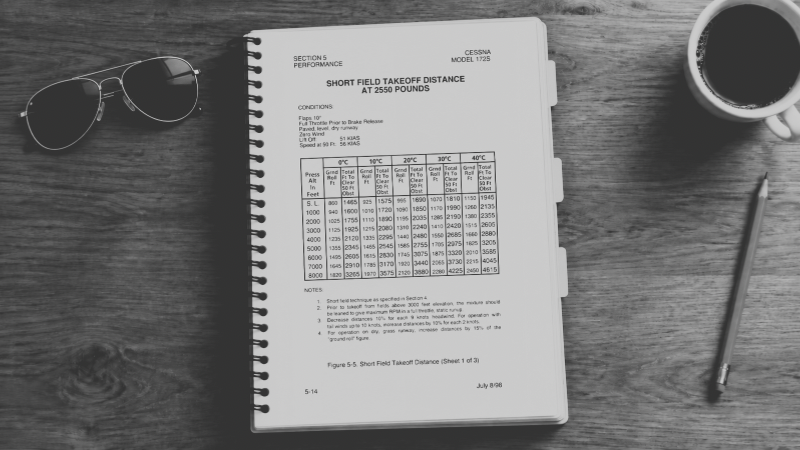
Two familiar training-aircraft examples make that distinction visible. In the Cessna 172S Information Manual, Revision 5, July 19, 2004, Section 5, Figure 5-5, sheet 1 of 3, printed page 5-14, the short-field takeoff table separates ground roll from total distance to clear a 50-foot obstacle. Its conditions include a paved, level, dry runway and zero wind.
The Piper PA-28-161 Warrior II handbook, Report VB-1180, uses separate graphs: Figure 5-7 on printed page 5-14 covers takeoff ground roll with zero-degree flaps; Figure 5-9 on page 5-15 covers takeoff distance over a 50-foot barrier with the same flap setting. Check both graphs' conditions before comparing their results.
These are references to the editions linked here, using printed manual pages rather than PDF page counts. They help illustrate the reading task; for flight planning, use the current POH/AFM and supplements applicable to the actual aircraft. The Cessna Information Manual explicitly identifies itself as a general reference that is not kept current.
Match the inputs to today's flight
Weight, atmospheric conditions, wind and the runway environment influence performance. Cooler air generally reduces density altitude when other conditions are equal, but it does not remove the effects of the other factors. The FAA's aircraft performance chapter explains these relationships and the importance of reading chart conditions and notes.
Use today's loading and the appropriate weather information. Keep track of the units and follow the chart's specified method. A careful calculation can still go astray if an input comes from a previous lesson or a unit is misread.
With your instructor, compare the ground-roll and obstacle-clearance results for one practice scenario in the applicable manual. Explain why they describe different distances, then return to today's flight.
Notice when the runway differs from the chart
A chart may assume a dry, level, paved runway. Read your aircraft's stated conditions rather than assuming they are the same for every chart. A different surface, slope or contamination can affect performance and whether the published data applies.
October provides a useful reason to practise this check. The air may be cool while the runway is wet, soft or affected by frost. Those are separate observations that need to be considered together.
If the conditions do not match, look for applicable aircraft guidance with your instructor. Do not invent a correction or extend a chart beyond its stated limits. When suitable information is unavailable, address that uncertainty in the flight decision and follow your school's procedures.
Transport Canada's PPL study and reference guide includes runway surfaces, slope, contamination and the use of approved aircraft information. These topics belong together because the surface beneath the aircraft matters alongside the air around it.
Bring the result back to the briefing
For your next lesson, ask to work through one performance calculation from the first note to the final answer. Explain which distance you calculated, where the inputs came from, and which conditions the chart assumes. Then discuss whether the result supports the planned operation with the margins required by applicable guidance and your school.
Keep the calculation connected to the actual technique. Published data does not promise that every attempt will reproduce the charted distance, and a planning margin does not make missing or inapplicable data valid.
Level Flight's Private Pilot Ground School covers aircraft performance as part of building practical aviation knowledge. Use that foundation with your instructor to understand the whole calculation, so the number you bring to the briefing means something clear.
Take Flight Now
Level Flight is Canada’s best online ground school. It is our mandate to provide higher quality, more engaging training for Canadian Student Pilots. If you are seeking the exhilarating freedom of flight for a hobby or with aspirations of a career in the skies, Level Flight offers the best ground school experience available. Sign up for our online learning platform now and discover the adventure that awaits you at Level Flight.
By submitting this form, you opt-in and give expressed consent to receiving SMS / text messages, calls, and emails from us for the purposes of communication related to your inquiry or related to the products and or services we provide.