
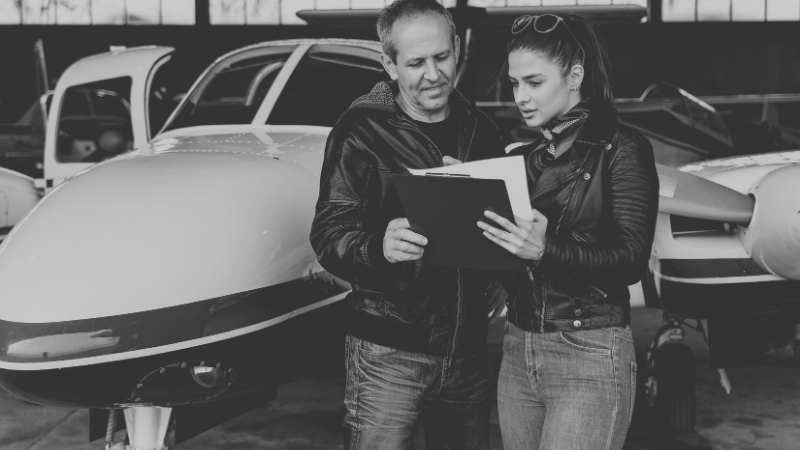
Most student pilots judge a flight lesson by how it felt in the moment, good or bad, and stop there. But those labels don't tell you what to actually do differently next time. This post breaks down why a real debrief requires more specific reflection: what changed, what improved, and where things started to break down, rather than a single overall verdict on the flight.
It offers a practical five-minute debrief template students can use right after landing, covering the lesson's objective, one specific improvement, the first point where things slipped, the likely cause (skill, prep, workload, fatigue, or conditions), and one clear next action. The goal is to help students walk away from every lesson, good or bad, with a focused plan instead of a vague feeling about how it went.
How to Debrief a Flight Lesson So the Next One Actually Improves
You shut the aircraft down, finish the paperwork, and walk away from the lesson with one of two feelings.
Either it was a good flight, and you feel like you are finally getting somewhere.
Or it was a bad flight, and you spend the drive home replaying every mistake.
Both reactions are normal. Neither one is a very useful debrief.
Flight training moves quickly. One lesson can include radio work, checklist use, airspeed control, circuit spacing, decision-making, workload management, and whatever the weather added that day. By the time it is over, it is easy to reduce everything to one label: good, bad, better, or worse.
The problem is that those labels do not tell you what to do next.
A useful debrief turns the lesson into specific information while the details are still fresh. It helps you understand your instructor's feedback, prepare with more direction, and arrive at the next lesson with one clear priority.
Why "Good" and "Bad" Are Not Enough
Student pilots often judge a flight by the part that felt most obvious.
If the landings were smooth, the whole lesson feels successful. If the radio calls were messy, the whole lesson feels frustrating. If one exercise fell apart, it can feel like the entire flight was a step backward.
But training rarely works that cleanly. You can have a rough landing lesson and still show better judgment than you did last week. You can fly a smooth circuit and still miss an important decision point. You can feel confident while quietly developing a habit that needs to be corrected.
Instead of asking only, "Was that a good flight?" ask, "What changed because of that flight?"
Did you recognize an error earlier? Recover faster? Stay more organized? Ask a better question? Discover that your preparation was too broad?
Those details show you where progress is happening and where the next lesson needs more attention.
Write It Down Before the Details Fade
The first few minutes after a lesson matter. You still remember the instruction your instructor gave you, the part of the circuit that felt rushed, and the moment you started falling behind the airplane.
Wait a few hours, and the story often becomes less useful. A frustrating lesson turns into "I was terrible today." A strong lesson becomes "I think I have this figured out."
Before you leave the airport, write down three things:
- What improved?
- What still needs work?
- What is the one focus for the next lesson?
Keep the answers short and specific.
Instead of "Landings were bad," write, "I carried extra speed on final and started the flare late."
Instead of "Radio work was better," write, "I made the downwind call without hesitation but missed one traffic update."
Specific notes give you something to act on. Vague notes usually create more pressure without improving your preparation.
Find Out Why It Broke Down
Not every mistake has the same cause.
Sometimes the issue is skill. You need more practice, repetition, or a clearer explanation.
Sometimes it is preparation. You did not review the procedure closely enough, so too much of your attention went toward remembering what came next.
Sometimes it is workload. The skill may be improving, but radio calls, traffic, wind, and instructor input arrived faster than you could organize them.
Fatigue and conditions matter too. Showing up tired, stressed, hungry, or mentally overloaded can affect a lesson before the engine starts. Wind, turbulence, a runway change, or a long gap between bookings can change how demanding familiar exercises feel.
This is not about making excuses. It is about assessing performance accurately.
A missed radio call might mean you need more communication practice. It might also mean you were task-saturated while correcting altitude, managing circuit spacing, and preparing for the next checklist item.
Safe pilots do not stop at what happened. They ask why it happened so they can choose the right response.
Turn Feedback Into One Next-Flight Priority
Your instructor's feedback is most useful when it becomes specific enough to guide your preparation.
"Work on your approaches" is a start, but it is not yet a plan. A clearer focus might be to stabilize the approach earlier, confirm the target airspeed before the runway picture takes over, and make smaller corrections instead of chasing the approach. Your instructor can help you decide which part matters most and how it fits your school's procedures and go-around criteria.
This matters when you receive a long list of feedback. Trying to fix radio calls, checklists, altitude, heading, lookout, decision-making, and confidence all at once usually creates more noise.
Ask your instructor:
- What is the most important thing to improve before the next lesson?
- What should I review before I come back?
- What would progress look like on the next flight?
A good debrief narrows the focus. It does not ask you to solve everything at once.
Use This Five-Minute Debrief
Use this template alongside your instructor's comments, not instead of them.
1. What was the main objective of today's flight?
Name the lesson focus: circuits, forced approaches, upper air work, navigation, radio confidence, or flight test preparation.
2. What improved?
Choose one specific improvement, even if the lesson was difficult.
3. What broke down first?
Identify the first point where workload, understanding, or technique started to slip. Do not list every error that followed.
4. Why did it break down?
Was the main factor skill, preparation, workload, fatigue, conditions, or pressure?
5. What is the next action?
Choose one clear task: review a procedure, chair-fly a sequence, revisit a ground school topic, write down a question for your instructor, or address fatigue before the next booking.
Five focused minutes are usually enough. The goal is not to create a perfect training journal. It is to leave with a useful plan.
One Flight Is Information, Not an Identity
One difficult lesson can feel bigger than it is, especially when you expected to be close to a milestone. Then you felt behind the airplane all day. The calls came late, the checklist flow felt clumsy, and your instructor stepped in more than you expected.
It is easy to turn that into a conclusion: "I should be further along" or "Maybe I am not cut out for this."
That reaction is understandable, but it is not an accurate debrief. One flight gives you information. It does not define your ability.
The same is true after a great lesson. One strong flight is encouraging, but it is not the same as consistency. The goal is to keep turning each lesson into better preparation, better questions, and better decisions.
After your next flight, resist the urge to stop at good or bad. Ask what changed, what needs attention, and what the next lesson should be built around.
If you want more structure between lessons, explore Level Flight's online ground school courses so you can study with more direction and bring clearer questions back to your instructor.
Take Flight Now
Level Flight is Canada’s best online ground school. It is our mandate to provide higher quality, more engaging training for Canadian Student Pilots. If you are seeking the exhilarating freedom of flight for a hobby or with aspirations of a career in the skies, Level Flight offers the best ground school experience available. Sign up for our online learning platform now and discover the adventure that awaits you at Level Flight.
By submitting this form, you opt-in and give expressed consent to receiving SMS / text messages, calls, and emails from us for the purposes of communication related to your inquiry or related to the products and or services we provide.