
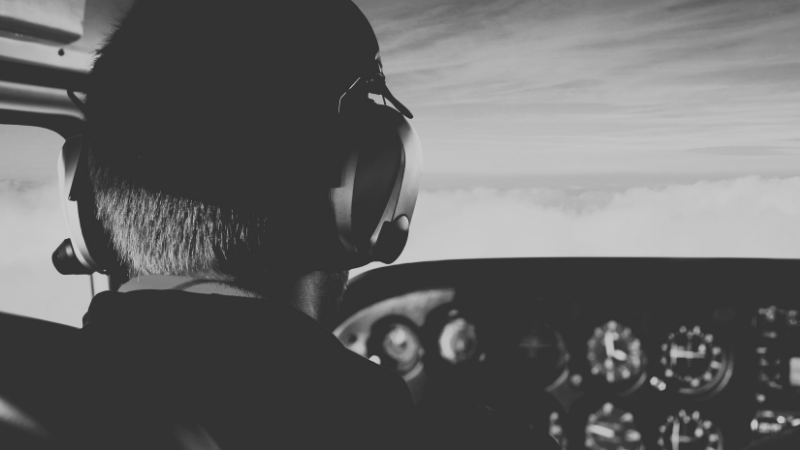
Preparing for a flight test is less about memorizing individual maneuvers and more about learning how to connect them into one smooth, complete flight. This article explains how common training exercises represent real-world flying situations and why understanding their purpose improves decision making and confidence. It highlights the importance of clarity, working within established standards, and thinking ahead to manage workload effectively. Ultimately, the flight test is presented not as the end of training, but as a checkpoint that confirms a student can apply knowledge, stay organized, and make safe decisions in real time.
Read the full article to better understand how to turn your training into confident, practical flying.
Flight Tests Mark a Shift in Training
Up to this point, you have been building skills piece by piece, practicing exercises individually while developing control and understanding over time. As you approach your flight test, the focus begins to change.
You are no longer being assessed only on individual exercises, but on how well everything comes together in one complete flight, where your knowledge, decision making, and aircraft control all work together in real time.
For many students, this is where things start to feel heavier. Not because they cannot fly, but because the expectation has shifted from practicing skills to applying them as a whole.
From Exercises to Real Situations
Sometimes, the biggest shift at this stage is how you begin to see the exercises you have been practicing.
Maybe you found some exercises that were easily connected to real flying. A forced approach, for example, clearly represents an engine failure, where time is limited and decisions matter.
Others can feel less obvious, but are just as important. Many of the exercises you practice are tied directly to real situations:
- Precautionary landings — Used when conditions are uncertain, like weather or unfamiliar terrain or even a new airport. A common error when executing these in practice or in reality is delaying the decision or rushing the assessment — failing to properly trim the aircraft, stay oriented, and clearly identify landmarks, which often leads to confusion and poor decision-making.
- Power-off stall — Represents low airspeed on approach, especially base to final. A common mistake is attempting to reach the runway by pitching up instead of accepting that the approach is no longer stable. This reduces airspeed, increases angle of attack, and brings the aircraft closer to a stall at a critical phase of flight. Recognizing this early and choosing to go around is a key part of safe decision-making.
- Power-on stall (departure stall) — Reflects excessive pitch during takeoff or overshoot. A common error is over-rotating or not managing pitch and power together.
- Slow flight — Simulates operating near stall speed during approaches or confined operations. The most common and critical error is failing to recognize the onset of these conditions, which leads to delayed or incorrect responses and significantly increases the risk of an accident.
- Steep turns — Represents high load factor maneuvering, like avoiding weather or traffic. A common error is losing altitude or fixating inside the flightdeck.
- Diversion — Reflects adapting to changing conditions like weather or routing. A common mistake is sticking to the original plan too long or becoming overloaded. Rushing the process often leads to a loss of stability, with poor trimming and inconsistent altitude control, causing the situation to compound instead of improve.
These are not random maneuvers or something you are doing just for a test — they reflect situations you may face in real flying. When you understand what they represent, your focus shifts from performing a maneuver to recognizing and responding to real-world conditions
Clarity and Flow
At this stage, most challenges are not about ability, but about clarity.
If you are unsure why you are doing something, it becomes harder to stay organized. Things feel rushed, and you are more likely to react late instead of thinking ahead.
When your understanding is clear, your flying becomes more controlled. You begin to anticipate what is coming next, your actions feel more deliberate, and your workload becomes more manageable.
A flight test is not a checklist of isolated maneuvers. It is a continuous sequence, where managing the flow of the flight supports strong decision making, but what ultimately matters is how well you meet the required standard throughout.
Working Within a Standard
Flight tests are assessed against clear standards, including altitude control, headings, airspeeds, and procedures.
These standards are not there to make things difficult. They exist to create consistency and support safe flying.
The goal is not perfection. Small deviations will happen. What matters is recognizing them early, correcting them smoothly, and then letting them go rather than allowing them to build into a bigger issue. Consistency and awareness are what demonstrate readiness.
Preparation and Decision Making
A lot of meaningful preparation happens before you even step into the aircraft.
Taking time to think through your flight, walk through sequences, and talk through decisions helps reduce the mental load in the air. When you have already worked through the flow, fewer things feel new.
Even then, not everything will go exactly as planned. That is part of flying. Mistakes will happen, and the key is to recognize them, correct them, and move on. What matters is staying composed and continuing to make safe decisions. If the flight is still going, you are still in the game.
Looking Beyond the Test
Before the flight begins, you will also be asked to talk through your aircraft, your planning, and your decisions. This is your opportunity to show that your understanding is clear and usable, not memorized, but connected.
A flight test is not the end of your training. It is a checkpoint that confirms you can apply what you have learned in a safe and practical way.
The habits you build now, such as staying organized, thinking ahead, and understanding why you are doing something, are the same habits that will carry into your flying moving forward.
One Final Question
Before your flight test, ask yourself:
Do I understand what I am doing, or am I just going through the motions?
Don’t worry, Level Flight has you covered with dedicated student support and resources every step of the way.
https://levelflight.ca/pages/student-support



The Level Flight Belief
We believe most student pilots don’t struggle because they lack ability — they struggle because they are overwhelmed, poorly guided, and unsure of what actually matters. Early flight training should create clarity and confidence, not confusion or self-doubt.
Level Flight exists to remove unnecessary complexity from ground school, focus learning on what truly matters, and give students clear standards and support from the very beginning. This is what sets our approach apart.


Level Flight Alumni Say
The number of Level Flight Ground School Pilots continues to grow. We are proud that our comprehensive and innovative Ground School curriculum inspires students to complete their first steps and continue to develop to achieve their aviation dreams. Here is what some of our students past and present say about their experience with Level Flight Ground School.
Take Flight Now
Level Flight is Canada’s best online ground school. It is our mandate to provide higher quality, more engaging training for Canadian Student Pilots. If you are seeking the exhilarating freedom of flight for a hobby or with aspirations of a career in the skies, Level Flight offers the best ground school experience available. Sign up for our online learning platform now and discover the adventure that awaits you at Level Flight.
By submitting this form, you opt-in and give expressed consent to receiving SMS / text messages, calls, and emails from us for the purposes of communication related to your inquiry or related to the products and or services we provide.